

Everest and Ama Dablam Grand Tour Trek
Our version of the Everest Three Passes: Renjo La and Cho La, the Gokyo lakes, Everest Base Camp and Ama Dablam Base Camp, all in one great trek.

Departure
Kathmandu

Season
Apr – May
Oct – Nov

Duration
20 days
Difficulty
Medium-High

Daily km
10-15 km

Max Altitude
Kala Patthar
5,644 m
April 2027
Our guide
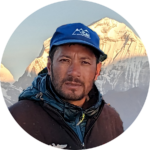
Bir “BibI” Bahadur
Day 01: arrival in Kathmandu, transfer to the hotel.
Day 02: free day, preparations and safety briefing in Kathmandu, gear check.
Day 03: morning minibus transfer to Manthali airport and flight to Lukla (2,846m), afternoon initial trek to Phakding (3-4 hours).
Day 04: trek from Phakding to Namche Bazaar (5-6 hours), crossing the Hillary suspension bridge.
Day 05: first acclimatization day in Namche Bazaar. Excursion to Syangboche and the Sherpa villages of Khunde and Khumjung, with a visit to Sagarmatha Next, a center dedicated to Khumbu culture, environmental protection and waste management in the Everest region (4-5 hours).
Day 06: trek from Namche Bazaar to Thame (3-4 hours).
Day 07: trek from Thame to Lungdhen (4-5 hours).
Day 08: trek from Lungdhen to Gokyo via the Renjo La Pass (5,360m) (4-5 hours).
Day 09: second acclimatization day with an excursion to Cho Oyu Base Camp (5,200m) (7-8 hours).
Day 10: trek from Gokyo to Dragnag (5-6 hours) with sunrise at the Gokyo Ri View Point (5,357m).
Day 11: trek from Dragnag to Dzonglha via the Cho La Pass (5,368m) (7-8 hours).
Day 12: trek from Dzonglha to the Pyramid International Laboratory/Observatory Evk2 CNR (4-5 hours).
Day 13: trek from Pyramid Evk2 CNR to Gorak Shep, trek to Everest Base Camp (5,364m) and return to Gorak Shep (6-7 hours).
Day 14: trek to watch sunrise over Everest from the top of Kala Patthar (5,644m) and return to Dingboche (6-7 hours).
Day 15: trek from Dingboche to Pangboche with a visit to the village of Chhukung (6-7 hours).
Day 16: trek from Pangboche to Ama Dablam Base Camp (4,600m) and return to Pangboche (7-8 hours).
Day 17: trek from Pangboche to Namche Bazaar (5-6 hours).
Day 18: trek from Namche Bazaar to Lukla (5-6 hours). Participation in Sagarmatha Next’s “Carry Me Back” project: those who wish can carry a 1 kg bag of waste for recycling from Namche to Lukla.
Day 19: morning flight from Lukla to Manthali, minibus transfer to Kathmandu, afternoon visit to the old town and final group dinner.
Day 20: buffer day or sightseeing in Kathmandu.
Request more information
- Transfers: Arrival and departure transfers from Kathmandu international airport.
- Accommodation in Kathmandu: 4 nights in a 3-star hotel in a double room (single on request) with breakfast (vegetarian and vegan options available).
- Connecting flights to Lukla: Flights included, with a baggage limit of 13 kg.
- Accommodation during the trek: Overnight stays in family-run lodges.
- Breakfast during the trek: breakfast at the lodge (vegetarian and vegan options available), including tea and coffee.
- Drinking water: 2 liters of boiled water per member per day, to be carried in water bottles or thermoses.
- Guide: Certified local guide with excellent English and, where available, Italian language skills.
- Porters: 1 porter for every 2 trekkers to carry personal luggage during the trek, up to 13 kg per participant.
- Duffel bag: Duffel bag for carrying luggage during the trek (delivered in Kathmandu).
- Permits: Permits required for the Everest Base Camp trek, including TIMS and the Sagarmatha National Park permit.
- Insurance: Insurance for all Nepalese staff involved.
- Medical Kit: First aid medical kit
- International flight to and from Kathmandu
- Nepal entry visa: ($50 for 30 days)
- Additional overnight stays in Kathmandu: in case of early arrival or delayed departure, or in case of an early return from the trek (for any reason) compared to the planned itinerary.
- Single room in Kathmandu: you can request a quote for a single room with a supplement of about €25 per night.
- Lunches and dinners in Kathmandu: you can request a quote for full board
- Lunches and dinners during the trek: you can request a quote for full board with a supplement of about €25 per day.
- Insurance: Travel insurance and high altitude, accident, medical, and emergency evacuation coverage.
- Personal Expenses: Nepalese SIM card, drinks, alcoholic beverages, personal gear, souvenirs and other purchases.
- Tips
- Other Costs: Any item not listed in the “What’s included” section.
What awaits you at E.B.C., the Gokyo lakes and Ama Dablam?

Our experience at your service, guiding you to the Gokyo lakes, Everest Base Camp and Ama Dablam
- Mountain boots or trekking shoes: sturdy and comfortable for rugged terrain.
- Mountain socks: enough pairs for daily changes.
- Merino wool or synthetic base layers: including tops and long pants.
- Breathable mid-layer top: for extra thermal insulation.
- Technical underwear: designed to keep your body dry.
- Waterproof jacket with hood: for protection against wind and light rain.
- Waterproof pant covers: breathable and water-resistant.
- Insulated jacket with hood: high thermal capacity for extreme cold.
- Insulated technical pants: full protection against rain and snow.
- Thermal top and base layer pants: comfortable for ease of movement.
- Lightweight, breathable gloves: for warmer days.
- Insulated gloves: for colder, windier conditions.
- Winter hat: wool or synthetic material.
- Sun hat: to protect against intense sun.
- Sunscreen: SPF 50 or higher
- Sunglasses with UV protection: essential against the strong solar radiation at high altitude.
- Trekking backpack: waterproof and lightweight, big enough to carry all necessary gear (20 liters recommended).
- Sleeping bag: rated for extremely low temperatures, down to -20°C or lower.
- Headlamp
- Universal adapter: for charging your phone, camera, etc.
- Power bank: electricity is not guaranteed in high-altitude lodges
- Large water bottle and thermos: at least 2 liters total
* Any missing gear can be bought or rented directly in Kathmandu.
F.A.Q. (Frequently Asked Questions)
It’s our version of the famous Everest Three Passes trek. The classic route crosses Renjo La, Cho La and Kongma La; we chose to cross Renjo La and Cho La and use the days saved to reach the Cho Oyu Base Camp and, above all, the Ama Dablam Base Camp.
This way we keep the two passes that, in our experience, add the most to the trip, and we add two places that are not normally part of the classic route.
We know the Everest region well and built the Grand Tour by choosing the stages that, in our view, make the trip more interesting. Renjo La offers one of the great views of the Khumbu and leads into the Gokyo valley; Cho La instead connects Gokyo with the Everest Base Camp area.
In our experience, Kongma La adds less than what we can experience by using those days differently. That’s why we chose to reach the Cho Oyu Base Camp and the Ama Dablam Base Camp instead, making the trip more varied and complete.
Cho Oyu is one of the 14 eight-thousanders and dominates the northern section of the Gokyo valley, toward the Tibetan border.
We included the hike to its base camp because it lets you explore a much less visited part of the Gokyo area and, at the same time, makes for a great day at altitude before continuing toward Cho La.
Ama Dablam is one of the most recognizable and spectacular mountains in the Himalaya, and it accompanies much of the journey through the Khumbu valley. Most itineraries heading to Everest Base Camp simply admire it from the trail.
We chose to dedicate a full day to reaching its Base Camp, entering the valley at the foot of the mountain. It’s one of the stages that most defines our Everest Grand Tour, and one of the reasons we chose this variant over the classic Three Passes route.
The Everest Grand Tour is more demanding than the Everest Base Camp trek. Besides its longer duration, it crosses two passes above 5,000 meters and includes longer, more physically demanding days, especially on the Renjo La and the Cho La.
You don’t need to be a mountaineer, but we recommend this trip to hikers already used to multi-day treks and with good physical fitness.
No mountaineering skills are required under normal trekking conditions. The Renjo La is a high-altitude trail, while the Cho La can feature snow, ice and steeper sections.
Conditions change with the season and the weather, though. In the presence of snow or ice, guides may recommend using microspikes or other suitable gear. The safety and passability of the passes are always assessed on site.
It’s designed for hikers in good health, with solid physical fitness, who are already used to walking in the mountains for many hours over several consecutive days.
You don’t need previous trekking experience in the Himalaya, but for those without high-altitude experience, this trip is more demanding than the Everest Base Camp trek, since you spend many days above 4,000 meters and repeatedly cross 5,000 meters.
In the weeks before departure, we recommend regular 6–8 hour hikes with 800–1,200 meters of elevation gain, gradually increasing duration and frequency.
It’s especially useful to train your endurance: the Grand Tour doesn’t require speed, but the ability to walk at a steady pace for many hours, recover, and set off again the next day.
Most days involve about 5–7 hours of walking. Days crossing the passes can be longer, requiring 7–9 hours, depending on terrain conditions, snow, and the group’s pace.
At high altitude, distance and kilometers matter less than elevation gain and altitude: a seemingly short stage can take much longer than a hike of the same distance in the Alps.
The itinerary includes a gradual ascent and days dedicated to acclimatization. The first is in Namche Bazaar; further on, we spend time in the Gokyo valley, climbing toward the Cho Oyu Base Camp before tackling the Cho La.
This allows you to spend several days between 4,000 and 5,000 meters before the most demanding stages of the trip. As with all our high-altitude treks, guides monitor participants’ conditions daily and the itinerary can be adjusted if necessary.
The most important thing is to ascend gradually, keep your own pace, and respect the acclimatization days. We recommend drinking plenty of water, eating regularly, avoiding alcohol, and not trying to keep up with faster participants.
If significant symptoms appear, the priority is not to complete the itinerary: stopping or descending in altitude remains the most effective measure to prevent the situation from worsening.
We especially recommend spring, between April and May, and fall, between late October and November.
For this trek, conditions matter even more than for the standard Everest Base Camp route, since snow and ice can make Renjo La and Cho La difficult or temporarily impassable. Pass conditions are always assessed by the guides during the trip.
English is always guaranteed. On this itinerary, the group is led by Bibi, Nepalese partner of Himalaya Exped and certified local guide, who speaks both Italian and English.
Italian-language support is therefore guaranteed for the entire duration of the trek.
Flights to Lukla can depart from Kathmandu or from Manthali airport, in Ramechhap, depending on operations during the season of your trip.
When flying from Manthali, we also arrange the transfer from Kathmandu. Round-trip flights to Lukla and the related transfers included in the itinerary are covered by the trip.
Lukla airport operates in a mountain environment, and flights depend heavily on weather conditions and visibility. Delays and cancellations are therefore a possibility to keep in mind.
Our itinerary builds in extra margin for the return leg, and in case of cancellations, we work together with the airline and our guides to adjust transfers and the schedule in the best possible way.
Yes. For treks in the Everest region, the TIMS Card and the entry permit for Sagarmatha National Park are required. Nepalese regulations also require these routes to be accompanied by a licensed guide.
Himalaya Exped arranges the guide and permits directly before the trek begins.
Yes. We ask all participants for travel insurance that covers trekking and rescue above 5,000 meters, including any medical expenses and emergency helicopter evacuation.
It’s important to check the maximum altitude limit of your policy: a standard travel insurance policy may not be enough for a trek that repeatedly goes above 5,000 meters.
The high number of trekkers, combined with the small size of Lukla airport, has driven a significant increase in flight prices from Manthali to Lukla. Since the 2024/2025 season, the fare is around $500 round trip per passenger.
In Kathmandu, we’ll give you a duffel bag to hand over to the porters. We typically plan for one porter for every two participants, with a maximum of 13 kg of personal luggage per person. Your duffel bag is carried ahead to the next stage and will be waiting for you once you reach the lodge.
It’s a concern we understand, but the issue isn’t using porters — it’s how they’re treated. For many families in mountain regions, working as a porter or guide is one of the few income opportunities linked to tourism, and refusing their work on principle doesn’t necessarily help them.
For Himalaya Exped, porters are part of the team. We work with local people and guarantee decent working conditions, insurance coverage during the trek, and clear limits on the weight carried. We generally provide one porter for every two participants, with a maximum of 13 kg of personal luggage per traveler.
To us, responsible tourism doesn’t mean taking work away from local communities — it means making sure that work is done with dignity, safety, and fair pay.
During the trek, you’ll only carry a light backpack, roughly 20–25 liters, with what you need for the day: water, a waterproof jacket, a warm layer, sunscreen, sunglasses, documents, a camera, and a few personal items.
The rest of your gear travels in the duffel bag carried by the porters.
Anything you don’t need during the trek can be safely left at the hotel in Kathmandu and picked up when you return.
For the flight to Lukla, our itinerary sets a luggage limit of 13 kg, so all you need during the trek is your duffel bag and the small daypack.
During the trek we sleep in the tea houses and lodges of the villages, usually in simple double rooms.
In Lukla, Phakding and Namche it’s easier to find rooms with a private bathroom. As we head into the more remote valleys of Thame, Lungdhen and Gokyo, and climb toward Dragnag, Dzongla, Pyramid and Gorak Shep, facilities become progressively more basic and shared bathrooms are much more common.
Our guides always look for the best accommodation available, but a private bathroom can’t be guaranteed at every stage. Rooms are normally unheated; lodges often heat the communal dining room instead.
Yes. During the Grand Tour we spend many nights above 4,000 meters, and lodge rooms aren’t heated.
We recommend a sleeping bag with a comfort rating of around -20 °C. If you don’t own one suited to Himalayan conditions, you can rent one in Kathmandu before departure.
Himalaya Exped provides 2 liters of drinking water per participant every morning, to be carried in your own water bottle or thermos. Additional boiled or bottled water can usually be purchased at the lodges.
Water straight from taps, fountains or streams should never be drunk without first boiling, filtering or treating it with a water purification product.
Lodges offer simple but fairly varied food: Dal Bhat, noodles, soups, rice, potatoes, pasta, eggs, momo and vegetarian dishes.
In the more remote valleys and at higher altitudes, the choice becomes more limited and prices rise, since everything has to be carried up into the mountains. Our guides tend to recommend simple, often vegetarian dishes in the more isolated lodges, especially when there’s no way to be sure meat has been stored properly.
They’re not essential, but it can be useful to bring a few energy bars, nuts or supplements you’re already used to using on hikes.
Above all, we recommend not trying new products during the trek.
The Grand Tour spends many days at high altitude and can be noticeably colder than the Everest Base Camp trek on pass days.
Above 4,000 meters, nighttime temperatures normally drop below freezing. Renjo La and Cho La are crossed early in the morning, and wind, snow and shade can make the temperature feel especially harsh.
During the day, with the sun out, it can actually feel relatively warm even at altitude. That’s why it’s essential to dress in layers and always carry wind protection and a warm layer.
Yes, in most lodges, but as you climb higher, charging is usually paid and electricity availability can be limited.
We recommend a high-capacity power bank, especially for the days in the Gokyo valleys and while crossing the passes. Cold weather also significantly reduces battery life.
In the main Khumbu valley, mobile coverage and Wi-Fi are fairly widespread, while in more remote areas around Thame, Lungdhen, Renjo La, Gokyo and Cho La the connection can become much more unreliable or disappear entirely.
We recommend buying a Nepal Telecom (NTC) SIM card in Kathmandu. Everest Link Wi-Fi is also available in many locations along the Everest route, but you shouldn’t count on a guaranteed connection throughout the Grand Tour.
It’s normal to spend entire days without a reliable network, so we recommend downloading maps, documents and anything else you might need offline before departure.
For travelers arriving from Europe, there are normally no mandatory vaccinations required to enter Nepal, except in special cases related to travel from or transit through countries at risk of yellow fever.
It’s still advisable to be up to date with routine vaccinations and to check with your doctor or a travel medicine center about those recommended for Nepal, such as hepatitis A and typhoid, based on your health status and the type of trip.

