
Annapurna Circuit Trekking

Trek to the Annapurna Circuit


The Annapurna Circuit is one of the great treks of the Himalaya, and our 22-day itinerary is designed to experience it fully, not just rush toward Thorong La. From the alpine side of Annapurna, the route climbs gradually toward Manang, passing through the villages of Ghyaru and Ngawal, before leaving the main trail for a few days to reach Tilicho Lake, at 4,919 meters, the highest lake in the world.

In Manang, we don’t spend our acclimatization day simply following the busy hike to Ice Lake. Instead, we climb up to Praken Gompa, a small Buddhist hermitage at nearly 4,000 meters, perched on the mountainside above the village. For decades, it has been a tradition here to bless travelers before they cross the Thorong La: our group also receives this blessing as a good omen for the rest of the trek. It’s one of those simple, authentic moments that, for us, capture the true meaning of traveling in the Himalaya, beyond the mountains and the views.

After acclimatizing in Manang, the journey continues to the Thorong La Pass, at 5,416 meters, before descending to Muktinath and into the desert landscape of Mustang. But for us, the Annapurna Circuit doesn’t end in Jomsom: we continue along the Kali Gandaki valley toward Tatopani and Poon Hill, finally reaching the southern side of Annapurna and the views of Mardi Himal, an area visited by far fewer organized Western groups and frequented mainly by Nepali hikers coming up from Pokhara.

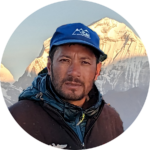
On our Annapurna Circuit, Italian-speaking support is guaranteed: the group is led by Bibi, Nepalese founding partner of Himalaya Exped and certified local guide, who knows this route inside out. We personally arrange transfers, lodges, permits and porters, from your arrival in Kathmandu through your return after the trek.


Only have two weeks?
You can experience the heart of the Annapurna Circuit in 15 days, following the same route as far as Jomsom through Manang, Tilicho Lake, the Thorong La Pass and Mustang.
Discover the Annapurna Circuit in two weeks →

Departure

Kathmandu

Best time to go

Apr – May
Oct – Nov

Duration

22 days

Difficulty

Medium

Daily km

10-15 km

Max Altitude

Thorong La Pass
5,416 m

Next departure

Our guide

Bir “BibI” Bahadur

Starting from

€1,949

Why choose Himalaya Exped for the Annapurna Circuit Trek?


Our guides have hiked the Annapurna Circuit more than 20 times and know this route stage by stage. It’s one of the treks closest to our hearts, and we’ve chosen to offer it in a full three-week version, without giving up the detours and paths that, in our view, make this journey truly extraordinary.

From Pisang, we reach Manang via the high route through Ghyaru and Ngawal, more scenic than the valley-floor trail. We stop in Manang for a day of acclimatization before temporarily leaving the main circuit to climb up to Tilicho Lake, at 4,919 meters. Only after this stage do we gradually tackle Yak Kharka, Thorong Phedi, and the Thorong La Pass at 5,416 meters.

Once past the pass, the landscape changes completely: you enter Mustang, through Muktinath, Lupra, and Jomsom. This is where our itinerary sets itself apart from shorter versions of the Annapurna Circuit. Instead of heading straight back to Pokhara, we continue along the Kali Gandaki valley to Tatopani, then on to Poon Hill and the southern side of Annapurna, all the way to Mardi Himal.

We built the itinerary this way because we want the three available weeks to truly showcase the many faces of the Annapurna: the green valleys of the early days, the high-altitude landscape of Manang and Tilicho, the Himalayan desert of Mustang, and finally the forests and sweeping views of the southern side.

Annapurna Circuit trek itinerary


Our Complete Annapurna Circuit runs over 22 days, including a rest day for acclimatization in Manang, a detour to Tilicho Lake, and a continuation past Jomsom through the Kali Gandaki, Poon Hill and Mardi Himal. The itinerary gradually alternates altitude gains with walking days to tackle the Thorong La Pass with proper acclimatization, while still leaving time to experience the different regions along the way.

Day 01: arrival in Kathmandu, transfer to the hotel, safety briefing and gear check.

Day 02: minibus transfer from Kathmandu to Besisahar.

Day 03: jeep transfer from Besisahar to Chame.

Day 04: trek from Chame to Pisang, through the village of Bhratang and alpine woods (6-7 hours).

Day 05: trek from Pisang to Manang, via the upper route through Ghyaru and Ngawal (7-8 hours).

Day 06: acclimatization day in Manang with a hike up to Praken Gompa, a small Buddhist hermitage at almost 4,000 meters, where the group will receive the traditional blessing before heading to higher altitudes.

Day 07: trek from Manang to the Tilicho Base Camp (7-8 hours).

Day 08: trek from T.B.C. to Tilicho Lake (4,919 m, the highest lake in the world) and back to Shinkarka (8-9 hours).

Day 09: trek from Shinkarka to Yak Kharka with breathtaking views over the Manang valley (4-5 hours).

Day 10: trek from Yak Kharka to Thorong Phedi (4-5 hours).

Day 11: trek from Thorong Phedi to Muktinath, crossing the Thorong La Pass (5,416 m, the highest point of the Annapurna Circuit) (6-8 hours).

Day 12: trek from Muktinath to Lupra (4-5 hours) and taxi or jeep transfer to Jomsom.

Day 13: morning visit to the Mustang Museum in Jomsom, then afternoon jeep transfer to Tatopani.

Day 14: trek from Tatopani to Shikha (4-5 hours).

Day 15: trek from Shikha to Ghorepani (3-4 hours).

Day 16: trek from Ghorepani to Tadapani, with a climb to admire the sunrise over the Dhaulagiri from Poon Hill (3,210 m) (5-6 hours).

Day 17: trek from Tadapani to Landruk (6-7 hours).

Day 18: trek from Landruk to Forest Camp (4-5 hours).

Day 19: trek from Forest Camp to Badal Danda (6-7 hours).

Day 20: trek from Badal Danda to Mardi View Point (4,200 m, the best viewpoint in the entire Himalaya for watching the sunrise over Annapurna) and return to Low Camp (7-8 hours).

Day 21: trek from Low Camp to Sidhing (3 hours) and jeep transfer to Pokhara.

Day 22: return by bus or flight from Pokhara to Kathmandu.

Request more information

Full Name(Required)

Included in the Annapurna Circuit Trek package


At Himalaya Exped, we carefully select our hotel, transport, and accommodation partners, and we use the best gear available to guarantee the highest possible safety standards. Your booking package includes the following:

  • Transfers: Arrival and departure transfers from Kathmandu international airport.
  • Accommodation in Kathmandu and Pokhara: 3 nights in a 3-star hotel in a double room (single on request) with breakfast (vegetarian and vegan options available).
  • Bus or flight connection to Pokhara
  • Accommodation during the trek: Overnight stays in family-run lodges.
  • Breakfast during the trek: breakfast at the lodge (vegetarian and vegan options available), including tea and coffee.
  • Drinking water: 2 liters of boiled water per member per day, to carry in water bottles or thermoses.
  • Guide: Bibi, a certified local guide fluent in Italian and English.
  • Porters: 1 porter for every 2 trekkers to carry personal luggage during the trek, up to 13 kg per participant.
  • Duffel bag: Duffel bag for carrying luggage during the trek (delivered in Kathmandu).
  • Permits: Permits required for the Annapurna Circuit, including TIMS and the Annapurna Conservation Area National Park permit.
  • Insurance: Insurance for all Nepalese staff involved.
  • Medical Kit: First aid medical kit

What’s not included


Not included in the base package, but we can add them or help you arrange them:

  • International flight to and from Kathmandu
  • Nepal entry visa: ($50 for 30 days)
  • Additional overnight stays in Kathmandu and/or Pokhara: in case of early arrival or delayed departure, or if you return early from the trek (for any reason) compared to the planned itinerary.
  • Single room in Kathmandu and/or Pokhara: you can request a quote for a single room with a supplement of about €25 per night.
  • Lunches and dinners in Kathmandu and Pokhara: you can request a quote for full board
  • Lunches and dinners during the trek: you can request a quote for full board with a supplement of about €25 per day.
  • Insurance: Travel and high-altitude insurance, accident, medical, emergency evacuation.
  • Personal Expenses: Nepalese SIM card, drinks, alcoholic beverages, personal gear, souvenirs and other purchases.
  • Tips
  • Other Costs: Any item not listed in the “What’s included” section.

What awaits you on the Annapurna?

Our experience at your service for treks on the Annapurna Circuit

Certified Expert Guides above 5,000 m

With Himalaya Exped, you can build your hiking skills through a trek program that includes high altitude acclimatization, while refining your technique for high-mountain progression in demanding weather conditions.

Our local experts share invaluable knowledge passed down through generations of mountain guides, putting their experience at your service to help you tackle the Himalaya safely.

Safety is our priority

At Himalaya Exped, we require all participants to take out adequate high-altitude rescue insurance covering medical expenses, evacuation and emergency transport above 5,000 meters.

All our guides and porters are insured: should the need arise, help will be fast and efficient, minimizing risks and complications for you and your fellow trekkers.

Environmental sustainability by design

Himalaya Exped is strongly committed to environmental sustainability, emphasizing the importance of leaving no trace and minimizing the use of plastic bottles during treks.

We promote staying at family-run lodges, supporting the local economy and reducing environmental impact. These practices help preserve the integrity of the Himalayan ecosystem, ensuring its natural beauty stays unspoiled for future generations of explorers… or for your next adventure.

Photo coverage

During the trek, we’ll document your adventure and provide you with all the photos you need. We make sure every moment of the journey is captured, from breathtaking sunsets to towering peaks, so you can bring home unique visual memories.

Our team of expert guides will not only lead you along the best routes for photography, but will also help you improve your photography skills in exceptional natural settings.

Recommended gear for the Annapurna Circuit Trek


To safely tackle the challenges of high-altitude trekking, having the right gear is essential.

  • Mountain boots or trekking shoes: sturdy and comfortable for rough terrain.
  • Wool hiking socks: enough for a daily change.
  • Merino wool or synthetic base layers: including tops and long pants.
  • Breathable mid layer: for extra thermal insulation.
  • Technical underwear: designed to keep your body dry.
  • Waterproof jacket with hood: for protection from wind and light rain.
  • Waterproof pants cover: breathable and water-resistant.
  • Insulated jacket with hood: high thermal capacity for extreme cold.
  • Insulated technical pants: for full protection against rain and snow.
  • Thermal top and base layer: comfortable for movement.
  • Lightweight, breathable gloves: for warmer days.
  • Insulated gloves: for colder, windier conditions.
  • Winter hat: wool or synthetic material.
  • Sun hat: to protect against intense sun.
  • Sunscreen: SPF 50 or higher
  • Sunglasses with UV protection: essential against the strong solar radiation at high altitude.
  • Trekking backpack: waterproof and lightweight, suitable for carrying necessary gear (20 liters recommended).
  • Sleeping bag: rated for extremely low temperatures, down to -20°C or lower.
  • Headlamp
  • Universal adapter: for charging your phone, camera, etc.
  • Power bank: electricity is not guaranteed at high-altitude lodges
  • Large water bottle and thermos: at least 2 liters combined

Ready to go?

Download the checklist!

* Any missing gear can be bought or rented directly in Kathmandu.

F.A.Q. (Frequently Asked Questions)

Who is the Annapurna Circuit suitable for?

The Annapurna Circuit is suitable for adult trekkers in good health who are adaptable and used to walking in the mountains. No previous experience in the Himalaya or mountaineering skills are required, but you need to be prepared to walk for several consecutive days and reach altitudes above 5,000 meters.

How can I train physically for the Annapurna Circuit?

We recommend arriving at the start of the trek already used to 6–8 hour hikes, gradually increasing distance and elevation gain in the weeks beforehand. Treks with 800–1,200 meters of elevation gain and regular cardiovascular training are especially useful. More than speed, what matters is the ability to keep a steady pace for many hours and recover well to set off again the next day.

How much do you walk each day on the Annapurna Circuit?

Most days involve 5–7 hours of walking covering about 10–15 km. Some stages are longer: the climb to Tilicho Lake and the Thorong La day can take 8–9 hours. Elevation gain varies widely from stage to stage and is distributed gradually along the route.

How do you manage acclimatization before the Thorong La?

The ascent is progressive. In Manang, we dedicate a day to acclimatization by climbing up to Praken Gompa, at almost 4,000 meters, and then returning to sleep at a lower altitude. Over the following days, we reach Tilicho Lake at 4,919 meters and continue through Yak Kharka and Thorong Phedi. This way, we spend several days at altitude before tackling the Thorong La at 5,416 meters.

Is the Thorong La Pass technically difficult?

The Thorong La doesn’t require any mountaineering techniques or climbing under normal trekking conditions. The difficulty comes mainly from the altitude of 5,416 meters, the length of the day, and the weather conditions. That’s why it’s tackled after several days of acclimatization, and departure is normally very early in the morning.

What’s the best time to go for the Annapurna Circuit?

We recommend spring, especially April and May, and autumn, particularly November. These are usually the most favorable seasons for trekking in the Annapurna region. In winter, snow and ice can make crossing the Thorong La more difficult or temporarily impossible.

Why does your Annapurna Circuit include Tilicho Lake?

For us, Tilicho Lake is one of the most spectacular stages of the entire trip and well worth the detour from the main route. It sits at 4,919 meters and is considered in Nepal to be the highest lake in the world. The climb also allows you to spend more time at high altitude before continuing on toward the Thorong La.

Is it better to do the full Annapurna Circuit or the two-week version?

Up to Jomsom, both itineraries share the stages we consider essential: Ghyaru and Ngawal, Manang, Praken Gompa, Tilicho Lake, Thorong La, Muktinath, and Mustang. The two-week version ends at Jomsom and continues on to Pokhara, while the full Circuit carries on along the Kali Gandaki to Tatopani and Poon Hill, ending on the Mardi Himal side. If you have three weeks available, the full Circuit lets you cross through many more of the Annapurna region’s different landscapes.

Is the Annapurna Circuit better than the Annapurna Base Camp?

It depends on what you’re looking for. The Annapurna Base Camp trek is shorter, reaches a maximum altitude of 4,130 meters, and leads into the great natural amphitheater of the Annapurna Sanctuary. The Annapurna Circuit is longer and far more varied: it crosses Manang, reaches Tilicho Lake and the Thorong La at 5,416 meters, enters Mustang, and changes scenery completely several times along the way. If you have the time and high altitude doesn’t worry you, we recommend the Annapurna Circuit.

What’s the difference between your Annapurna Circuit and the shorter itineraries I find online on other agencies’ websites or YouTube?

We’ve chosen not to reduce the Circuit to just the Thorong La crossing. Our full itinerary includes the high route through Ghyaru and Ngawal, acclimatization in Manang with a climb up to Praken Gompa, the detour to Tilicho Lake, and, after Jomsom, the continuation along the Kali Gandaki toward Poon Hill and Mardi Himal. It’s designed for those who want to spend three weeks discovering the many different faces of the Annapurna region.

Do you need a guide, and which permits are required for the Annapurna Circuit?

Yes. The Annapurna Circuit is one of the itineraries for which Nepalese regulations require an authorized guide and the TIMS Card. A permit for the Annapurna Conservation Area (ACAP) is also required. Himalaya Exped arranges the guide and permits directly before the trek begins.

What language does the guide speak?

English is always guaranteed. On this itinerary the group is accompanied by Bibi, Nepalese partner of Himalaya Exped and certified local guide, who speaks both Italian and English.
Support in Italian is therefore guaranteed for the entire duration of the trek.

What temperatures will I find on the Annapurna Circuit?

Temperatures vary enormously during the trip because you cross very different environments and altitudes. In the lower valleys and in Kathmandu or Pokhara, days can be mild or even warm, while heading up toward Manang, Tilicho Lake and Thorong La, temperatures drop rapidly.

Above 4,000 meters, it’s normal to find below-freezing temperatures at night and in the early morning hours. The Thorong La day starts very early and can be especially cold, particularly if it’s windy or on departures closer to winter. With the sun out, though, even at altitude during the day the temperature can feel pleasant.

For this reason, your gear should allow you to dress in layers, so you can quickly adapt from relatively warm conditions to cold, wind and possible precipitation.

Do I need to bring a sleeping bag?

Yes. Lodge rooms at altitude are not heated, and it can get very cold at night. We recommend a sleeping bag suited to low temperatures, with a comfort rating of -20 °C; if you don’t own one suitable for Himalayan conditions, you can rent one in Kathmandu before departure.

How is luggage transported during the trek?

In Kathmandu, we’ll give you a duffel bag to hand over to the porters. We normally arrange one porter for every two participants, with a maximum of 13 kg of personal luggage per person. The duffel bag is carried ahead to the next stage and will be waiting for you once you arrive at the lodge.

Where do you sleep? Is there a bathroom in the room?

During the trek, we stay in tea houses and village lodges, usually in simple double rooms. In more developed villages, rooms with a private bathroom are often available, while higher up it’s more common to have a shared bathroom. Our guides always try to book the best accommodation available, but a private bathroom can’t be guaranteed at every stage.
Rooms are usually unheated; at higher-altitude lodges, a stove is often lit in the shared dining room. In Kathmandu and Pokhara, we stay in 3-star hotels in a double room with private bathroom and breakfast included.

What backpack should I carry during the day?

During the trek, you’ll only carry a light backpack, roughly 20–25 liters, with what you might need during the day: water, a waterproof jacket, a warm layer, sunscreen, sunglasses, documents, a camera and small personal items. The rest of your gear travels in the duffel bag entrusted to the porters.

Where can I leave the suitcase I use for my flight?

Anything you don’t need during the trek can be safely stored at the hotel in Kathmandu and picked up when you return. On the trail, you’ll only need to carry your trekking duffel bag and a small daypack.

Do I need any special vaccinations to travel to Nepal?

Travelers arriving from Italy are generally not required to have any mandatory vaccinations to enter Nepal, except in specific cases involving travel from or transit through countries at risk of yellow fever. That said, it’s advisable to be up to date with routine vaccinations and to consult your doctor or a travel medicine center about vaccines recommended for Nepal, such as hepatitis A and typhoid, depending on your health status and the type of trip you’re planning.

Where do you get drinking water during the trek?

Every morning, Himalaya Exped provides 2 liters of drinking water per participant, to be poured into your own water bottle or thermos. In the lodges, it’s usually possible to buy extra boiled or bottled water.
Water straight from taps, springs, or streams should never be drunk without first boiling, filtering, or treating it with a purification product.

Can I recharge my phone, camera, etc. during the trek?

Yes. Most lodges let you recharge phones, cameras, and other electronic devices. At lower altitudes, charging is often free, while higher up it’s common to be charged a small fee, and electricity may only be available at certain times of day.

We still recommend bringing a high-capacity power bank, especially for the days between Manang, Tilicho Lake, and Thorong La, where power availability is more limited. At high altitude, the cold also drains batteries faster.

Is there phone signal and Wi-Fi during the Annapurna Circuit?

Yes, but don’t expect to be connected at all times. In lower villages and main hubs like Chame, Pisang, and Manang, mobile coverage is generally good, and many lodges also offer Wi-Fi, sometimes for a fee. Heading up toward Tilicho Lake, Yak Kharka, and Thorong La, the signal becomes far more unreliable and can disappear completely in some stretches.

We recommend buying a Nepal Telecom (NTC) SIM card at the airport or at one of the shops near your hotel, as it generally offers better coverage than Ncell in the mountains. After Thorong La, the connection gradually becomes more stable again toward Muktinath and Jomsom.

During a trek in the Himalaya, it’s still normal to spend a few hours or even entire days without a reliable connection: before you leave, we recommend downloading anything you might need on your phone for offline use.

I don’t want to use a porter because I’m afraid of exploiting them. Is it really necessary?

It’s a concern we understand, but the issue isn’t using porters — it’s how they’re treated. Working as a porter or guide is, for many families in the mountain regions, one of the few sources of income linked to tourism, and refusing their work on principle doesn’t necessarily help them.

At Himalaya Exped, porters are part of the team. We work with local people, guarantee fair working conditions, provide insurance during the trek, and set clear limits on the weight they carry. We typically assign one porter for every two participants, with a maximum of 13 kg of personal luggage per traveler.

For us, responsible tourism doesn’t mean taking work away from local communities — it means making sure that work is carried out with dignity, safely, and with fair pay.

What do you eat during the trek?

Lodges offer simple but fairly varied food. The quintessential Nepali dish is Dal Bhat: rice, lentil soup, vegetables and curry — nutritious and perfect for trekking days. Noodles, soups, fried rice, potatoes, pasta, eggs, momo, and various vegetarian dishes are also common.
As you climb higher, the choice becomes more limited. Our guides tend to recommend simple dishes, often vegetarian in the more remote lodges, especially when there’s no guarantee that meat has been properly stored.

Should I bring energy supplements with me?

They aren’t essential, but it can be helpful to bring along a few bars, dried fruit, or supplements you’re already used to using on hikes. We especially recommend bringing products you know you tolerate well, rather than trying something new for the first time during the trek.