

Everest Base Camp Trek
Live the mountaineering legend: join us on the world’s most coveted trek

Departure
Kathmandu

Best Time to Go
Apr – May
Oct – Nov

Duration
16 days
Difficulty
Medium

Daily distance
10-15 km

Max altitude
Kala Patthar
5,644 m
October 17, 2026
Our guide
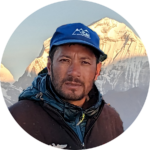
Bir “BibI” Bahadur
Request more information
Day 01: arrival in Kathmandu, transfer to the hotel.
Day 02: free day, preparations and safety briefing in Kathmandu, gear check.
Day 03: morning transfer by van to Manthali airport and flight to Lukla (2,846m), afternoon initial trek to Phakding (3-4 hours).
Day 04: trek from Phakding to Namche Bazaar (5-6 hours), crossing the Hillary suspension bridge.
Day 05: first acclimatization day at Namche Bazaar. Excursion to Syangboche and the Sherpa villages of Khunde and Khumjung, with a visit to Sagarmatha Next, a center dedicated to Khumbu culture, environmental protection, and waste management in the Everest region (4-5 hours).
Day 06: trek from Namche Bazaar to Phortse, visit to Tengboche Monastery (5-6 hours).
Day 07: trek from Phortse to Dingboche (5-6 hours).
Day 08: second acclimatization day at Dingboche. Excursion to the village of Chhokung (3-4 hours).
Day 09: trek from Dingboche to the Ev-K2-CNR International Pyramid Observatory, passing through the Everest Memorial Pass at Thukla (5-6 hours).
Day 10: trek from the Ev-K2-CNR Pyramid to Gorak Shep, trek to Everest Base Camp and back to Gorak Shep (6-7 hours).
Day 11: trek to watch sunrise over Everest from the summit of Kala Patthar and return to Pheriche (6-7 hours).
Day 12: trek from Pheriche to Namche Bazaar (7-8 hours).
Day 13: trek from Namche Bazaar to Phakding (4-5 hours). Before departure, participation in Sagarmatha Next’s “Carry Me Back” project: those who wish can pick up a bag with 1 kg of waste already prepared for recycling in Namche, to be carried down to Lukla.
Day 14: trek from Phakding to Lukla (3-4 hours) and drop-off of the bags carried for the “Carry Me Back” project at the Lukla collection station.
Day 15: morning flight from Lukla to Manthali, transfer by minibus to Kathmandu, afternoon visit to the old city and final group dinner.
Day 16: spare day or visit to Kathmandu.
- Transfers: Arrival and departure transfers from Kathmandu international airport.
- Accommodation in Kathmandu: 3 nights in a 3-star hotel in a double room (single on request) with breakfast (vegetarian and vegan options available).
- Connecting flights to Lukla: round-trip flights from Manthali or Kathmandu, depending on the season’s airport operations, with a 13 kg baggage limit.
- Accommodation during the trek: Overnight stays in family-run lodges.
- Breakfast during the trek: breakfast at the lodge (vegetarian and vegan options available), including tea and coffee.
- Drinking water: 2 liters of boiled water per member per day, to be carried in water bottles or thermoses.
- Guide: Bibi, certified local guide, accompanying the group in Italian and English.
- Porters: 1 porter for every 2 trekkers to carry personal luggage during the trek, maximum 13 kg per participant.
- Duffel bag: Duffel bag for carrying luggage during the trek (delivered in Kathmandu).
- Permits: Permits required for the Everest Base Camp trek, including TIMS and the Sagarmatha National Park permit.
- Insurance: Insurance coverage for all Nepalese staff involved.
- Medical Kit: First aid medical kit
- International flights to and from Kathmandu
- Nepal entry visa: ($50 for 30 days or $30 for 15 days)
- Additional overnight stays in Kathmandu: in case of early arrival or delayed departure, or in case of an early return from the trek (for any reason) compared to the planned itinerary.
- Single room in Kathmandu: you can request a quote for the single room with a supplement of about €25 per night.
- Lunches and dinners in Kathmandu: you can request a quote for full board
- Lunches and dinners during the trek: you can request a quote for full board with a supplement of about €25 per day.
- Insurance: Travel and high altitude insurance, accident, medical, and emergency evacuation coverage.
- Personal Expenses: Nepalese SIM card, soft drinks, alcoholic beverages, personal gear, souvenirs and other purchases.
- Tips
- Other Costs: Any item not listed in the “What’s included” section.
What landscapes await you on the trek to Everest Base Camp?

Our experience at your service to guide you to Everest Base Camp
- Mountain boots or trekking boots: sturdy and comfortable for rough terrain.
- Mountain socks: enough for a daily change.
- Merino wool or synthetic base layers: including tops and long pants.
- Breathable mid layer: for extra thermal insulation.
- Technical underwear: designed to keep your body dry.
- Waterproof jacket with hood: for protection from wind and light rain.
- Waterproof overpants: breathable and water-resistant.
- Insulated jacket with hood: high thermal capacity for extreme cold.
- Insulated technical pants: for full protection against rain and snow.
- Thermal shirt and base layer pants: comfortable for movement.
- Lightweight, breathable gloves: for warm days.
- Insulated gloves: for the coldest, windiest conditions.
- Winter hat: wool or synthetic material.
- Sun hat: to protect against intense sun.
- Sunscreen: SPF 50 or higher
- Sunglasses with UV protection: essential given the strong solar radiation at high altitude.
- Trekking backpack: waterproof and lightweight, suitable for carrying the necessary gear (20 liters recommended).
- Sleeping bag: rated for extremely low temperatures, down to -20°C or lower.
- Headlamp
- Universal adapter: for charging your phone, camera, etc.
- Power bank: electricity is not guaranteed at high-altitude lodges
- Large water bottle and thermos: at least 2 liters in total
* Any missing gear can be bought or rented directly in Kathmandu.
F.A.Q. (Frequently Asked Questions)
The Everest Base Camp trek is suitable for adult hikers in good health, with a spirit of adaptability and already used to walking in the mountains. No previous Himalaya experience or mountaineering skills are required, but you need to be prepared to walk for several consecutive days and spend multiple days above 4,000 meters.
It presents no mountaineering difficulties or technical passages: the trails are generally well marked, and no ropes, crampons or climbing techniques are needed under normal trekking conditions.
The difficulty comes mainly from the altitude, the length of the trip and the many consecutive days of walking. The highest point is Kala Patthar, at 5,644 meters.
We recommend arriving at the start already used to 6–8 hour hikes, gradually increasing distance and elevation gain in the weeks before departure. Treks with 800–1,200 meters of elevation gain and regular cardio training are especially useful.
Speed matters less than the ability to keep a steady pace for many hours and recover well enough to set off again the next day.
Most days involve around 5–7 hours of walking, generally covering 10–15 km. Some stages are longer, especially on the way down.
In the Himalaya, distance alone doesn’t tell the whole story: altitude, elevation gain and terrain affect the day’s effort far more than distance does.
Our itinerary includes two days dedicated to acclimatization. The first is in Namche Bazaar, with a hike toward Khunde and Khumjung; the second is in Dingboche, with a climb toward Chhukung.
These aren’t wasted days: climbing during the day and returning to sleep lower down helps the body adapt gradually. Only after Dingboche do we stay consistently above 4,500 meters, reaching the Ev-K2-CNR Pyramid before continuing on to Gorak Shep and Everest Base Camp.
The most important thing is to climb gradually and respect acclimatization schedules. During the trek, we recommend keeping your own pace rather than trying to match others’, drinking plenty of water, eating regularly and avoiding alcohol, especially as you gain altitude.
Our guides check on participants’ condition every day. If significant symptoms appear, the priority isn’t reaching the planned stage but stopping or descending in altitude when necessary.
Everest Base Camp sits at 5,364 meters on the Khumbu glacier and is the point from which expeditions to the Everest summit set off. From there, though, the view of the mountain is partly hidden by the surrounding peaks.
To really see Everest, we instead climb up to Kala Patthar, at 5,644 meters. It’s the highest point of our trek and offers one of the most famous views of Everest, along with Lhotse, Nuptse, Pumori and Ama Dablam.
Before reaching Gorak Shep, we chose to spend a night at the Pyramid, the international laboratory-observatory built in 1990 by the Italian CNR in the Khumbu valley at around 5,050 meters.
It’s an uncommon stage in standard Everest Base Camp itineraries, and it holds special meaning for us: it lets you discover one of the most important Italian scientific projects carried out in the Himalaya, and spend an extra night at altitude before reaching Base Camp.
The seasons we recommend are spring, especially between April and May, and autumn, between late October and November. These are normally the most favorable periods for stable weather and mountain visibility.
In winter the trek is still possible, but temperatures get much colder and snow can make the route more difficult. During the monsoon, on the other hand, rain and clouds make both the trek and flights to Lukla less favorable.
English is always guaranteed. On this itinerary, the group is accompanied by Bibi, a Nepalese partner of Himalaya Exped and certified local guide, who speaks both Italian and English.
Support in Italian is therefore guaranteed for the entire duration of the trek.
Flights to Lukla can depart from Kathmandu or from Manthali airport, in Ramechhap, depending on the flight operations scheduled for the season of your trip.
When flying from Manthali, we also arrange the transfer from Kathmandu. All round-trip flights to Lukla and the related transfers included in the itinerary are covered by the trip price.
Lukla airport operates in a mountain environment, and flights depend heavily on weather conditions and visibility. Delays and cancellations are therefore part of what to expect when planning a trek in the Everest region.
That’s why our itinerary includes a buffer day in Kathmandu at the end of the trip. In the event of a cancellation, we work together with the airline and our guides to rearrange the transfer and adapt the itinerary in the best possible way.
A significant part of the cost is tied to the round-trip flights to Lukla, needed to reach the Khumbu valley. Lodges, cargo transport, and services also become progressively more expensive at higher altitude, since almost everything must be carried up the mountain by air, pack animal, or on foot.
Our trip price already includes flights to Lukla, lodges, breakfasts, guide, porters, permits, and the transfers included in the itinerary.
Yes. The Everest Base Camp trek requires the TIMS Card and the Sagarmatha National Park entry permit. Nepalese regulations also require a licensed guide to accompany you along this route.
Himalaya Exped arranges all permits directly before the trek begins.
Yes. We ask all participants to have travel insurance that covers trekking and high-altitude rescue above 5,000 meters, including any medical expenses and emergency helicopter evacuation.
It’s important to check your policy’s altitude limit carefully: a standard travel insurance policy may not be enough for an itinerary that reaches 5,644 meters.
In Kathmandu, we’ll give you a duffel bag to hand over to the porters. We typically provide one porter for every two participants, with a maximum of 13 kg of personal luggage per person. The duffel bag is carried to the next stage and will be waiting for you once you reach the lodge.
It’s a concern we understand, but the issue isn’t using porters — it’s how they’re treated. Working as a porter or guide is one of the few tourism-related income opportunities for many families in mountain regions, and refusing their work on principle doesn’t necessarily help them.
At Himalaya Exped, porters are part of the team. We work with local people, guarantee fair working conditions, insurance during the trek, and strict weight limits. We typically provide one porter for every two participants and a maximum of 13 kg of personal luggage per traveler.
For us, responsible tourism doesn’t mean taking work away from local communities — it means making sure that work is done with dignity, safety, and fair pay.
During the trek you’ll only carry a light backpack, roughly 20–25 liters, with what you need for the day: water, a waterproof jacket, a warm layer, sunscreen, sunglasses, documents, camera, and a few personal items.
The rest of your gear travels in the duffel bag carried by the porters.
Anything you don’t need during the trek can be safely left at the hotel in Kathmandu and picked up when you return.
For the flight to Lukla, our itinerary allows for a 13 kg baggage limit: during the trek, you’ll only need your duffel bag and small daypack.
During the trek we stay in tea houses and village lodges, usually in simple but comfortable double rooms.
In Lukla, Phakding, and Namche, rooms with a private bathroom are easier to find. Higher up, toward Tengboche, Dingboche, Pyramid, and Gorak Shep, facilities become more basic and shared bathrooms are much more common. Our guides always try to secure the best accommodation available, but a private bathroom can’t be guaranteed at every stage.
Rooms are usually unheated, while the shared dining room at the lodge is often heated. In Kathmandu we stay at a 3-star hotel in a double room with private bathroom and breakfast included.
Yes. At high altitude, rooms are not heated and nights can get very cold. We recommend a sleeping bag with a comfort rating of around -20 °C.
If you don’t own one suited to Himalayan conditions, you can rent one in Kathmandu before departure.
Himalaya Exped provides 2 liters of drinking water per participant every morning, to be carried in your own water bottle or thermos. At the lodges, it’s usually possible to buy additional boiled or bottled water.
Water straight from taps, fountains or streams should not be drunk without first being boiled, filtered or treated with a water purification product.
The lodges offer simple but fairly varied food. The most common Nepalese dish is Dal Bhat, made of rice, lentil soup, vegetables and curry, which is particularly well suited to trekking days.
Noodles, soups, fried rice, potatoes, pasta, eggs, momos and vegetarian dishes are also common. The higher you go, the more limited the choice becomes and the higher the prices, since all goods have to be carried up the valley.
Our guides tend to recommend simple dishes, and often vegetarian ones at the more remote lodges, especially when there’s no way to be sure meat has been stored properly.
They’re not essential, but it can be handy to bring a few energy bars, nuts, or supplements you’re already used to using on hikes.
We especially recommend bringing products you know you tolerate well, and avoiding trying new foods or supplements during the trek.
Temperatures vary a lot depending on altitude and time of year. During the first stages between Lukla, Phakding, and Namche, days can be relatively mild, while above 4,000 meters the cold becomes progressively more intense.
In Dingboche, Pyramid, and Gorak Shep, it’s normal to find below-freezing temperatures at night and in the early morning hours. The climb to Kala Patthar starts very early and can be one of the coldest moments of the entire trip, especially in windy conditions.
During the day, with the sun out, the perceived temperature can be surprisingly pleasant. That’s why it’s essential to dress in layers and always carry a warm layer and wind protection.
Yes. Most lodges let you recharge phones, cameras, and other electronic devices. In the lower stages it may be free, while at higher altitudes a fee is usually charged.
We still recommend bringing a high-capacity power bank. Above Dingboche, power availability becomes more limited and the cold significantly shortens battery life.
In the lower part of the valley and in the main villages, phone coverage is generally available, but it becomes more unreliable the higher you go toward Everest Base Camp.
We recommend buying a Nepali SIM card in Kathmandu; Nepal Telecom (NTC) has coverage in the Everest region. At high altitude, though, you shouldn’t rely on mobile networks alone.
Along most of the route, Everest Link is also available — a Wi-Fi network dedicated to the region with hotspots in places like Lukla, Namche Bazaar, Tengboche, Dingboche, Lobuche, Gorak Shep, and even Everest Base Camp. The service usually comes at a cost.
Even on the Everest trek, it’s normal to go through periods without a stable connection. We recommend downloading maps, documents, and anything useful offline before you leave.
For travelers coming from Italy, there are usually no mandatory vaccinations required to enter Nepal, except in specific cases related to travel from or transit through countries at risk of yellow fever.
That said, it’s advisable to be up to date with routine vaccinations and to check with your doctor or a travel medicine clinic about those recommended for Nepal, such as hepatitis A and typhoid, based on your health and the type of trip.

